100 Days of RTL
I think small thinks could solve complex problems in any domine
Introduction
Completing the #100DaysOfRTL challenge changed me a lot. When I started, my main goal was to better understand RTL design by practicing regularly. I didn't realize how much it would improve my skills, mindset, and career perspective.
RTL design isn’t just about coding in Verilog it’s about thinking in hardware. Once I understood this, my entire perspective on digital electronics changed. However, I struggled with maintaining consistency. While I understood the theory, applying it to create functional code and verified designs required discipline. This challenge pushed me to code daily, document my progress, and develop habits that would prepare me for the industry.
Throughout the 100 days,
| Day | Task | link |
| Day 1 | AND Gate using Verilog HDL. | Click me for code capsule |
| Day 2 | OR Gate. | Click me for code capsule |
| Day 3 | NOT Gate. | Click me for code capsule |
| Day 4 | NAND Gate. | Click me for code capsule |
| Day 5 | NOR Gate. | Click me for code capsule |
| Day 6 | XOR Gate. | Click me for code capsule |
| Day 7 | XNOR Gate. | Click me for code capsule |
| Day 8 | Half Adder. | Click me for code capsule |
| Day 9 | Full Adder. | Click me for code capsule |
| Day 10 | 4-bit Full Adder using Verilog. | Click me for code capsule |
| Day 11 | Ripple Carry Adder (4-bit). | Click me for code capsule |
| Day 12 | 2:1 Multiplexer. | Click me for code capsule |
| Day 13 | Half Subtractor using Verilog HDL. | Click me for code capsule |
| Day 14 | Full Subtractor in Verilog HDL. | Click me for code capsule |
| Day 15 | 4-bit Adder/Subtractor in Verilog HDL. | Click me for code capsule |
| Day 16 | Carry Lookahead Adder (CLA) in Verilog HDL. | Click me for code capsule |
| Day 17 | 4:1 Multiplexer using Verilog HDL. | Click me for code capsule |
| Day 18 | Inverter using a 2:1 MUX. | Click me for code capsule |
| Day 19 | 5:1 Multiplexer using only 2:1 MUXes. | Click me for code capsule |
| Day 20 | 8:1 Multiplexer. | Click me for code capsule |
| Day 21 | Full Subtractor using 8x1 MUX. | Click me for code capsule |
| Day 22 | Full Subtractor using 4x1 Multiplexers in Verilog HDL. | Click me for code capsule |
| Day 23 | Full Subtractor using only 2:1 Multiplexers. | Click me for code capsule |
| Day 24 | 3-bit Gray to Binary Converter using 4:1 MUXes. | Click me for code capsule |
| Day 25 | 10x1 Multiplexer using 4x1 Multiplexers. | Click me for code capsule |
| Day 26 | 1:2 Demultiplexer (DEMUX). | Click me for code capsule |
| Day 27 | 1:4 Demux in Verilog today. | Click me for code capsule |
| Day 28 | Full Adder using 1:4 Demux. | Click me for code capsule |
| Day 29 | 1:2 Demux using a 1:4 Demux. | Click me for code capsule |
| Day 30 | 4:1 MUX using 2:1 MUXes. | Click me for code capsule |
| Day 31 | 1:4 DeMUX using 1:2 DeMUX. | Click me for code capsule |
| Day 32 | Encoder vs Priority Encoder – Quick Difference. | Click me for code capsule |
| Day 33 | 8:3 Encoder vs 8:3 Priority Encoder. | Click me for code capsule |
| Day 34 | 3:8 Decoder using 2:4 Decoders. | Click me for code capsule |
| Day 35 | Gray to Binary Converter using 3:8 Decoder. | Click me for code capsule |
| Day 36 | N-bit Full Adder using Parameter Overriding. | Click me for code capsule |
| Day 37 | 2-to-4 Decoder using 4:1 MUX. | Click me for code capsule |
| Day 38 | 4-to-2 Encoder using 2:1 MUX. | Click me for code capsule |
| Day 39 | 1-bit comparator in Verilog HDL. | Click me for code capsule |
| Day 40 | 2-bit comparator in Verilog by instantiating and connecting multiple 1-bit comparator modules from the previous design. | Click me for code capsule |
| Day 41 | N-bit comparator in Verilog using parameterized. | Click me for code capsule |
| Day 42 | Binary-to-Gray Code Converter in Verilog HDL. | Click me for code capsule |
| Day 43 | Gray-to-Binary code conversion in Verilog HDL. | Click me for code capsule |
| Day 44 | N-bit Full Adder | Click me for code capsule |
| Day 45 | 7:1 Multiplexer using 2:1 Multiplexers | Click me for code capsule |
| Day 46 | Designed a 3-bit Operation ALU using Verilog HDL. | Click me for code capsule |
| Day 47 | A deep dive into Verilog event scheduling and specifically what happens at the c (Non-Blocking Assignment region). | Click me for code capsule |
| Day 48 | Simple 8x8 Synchronous RAM in Verilog HDL. | Click me for code capsule |
| Day 49 | Prime number checking in Verilog. | Click me for code capsule |
| Day 50 | Factorial module in Verilog HDL using a recursive function. | Click me for code capsule |
| Day 51 | NOR latch (SR latch using cross-coupled NOR gates) in Verilog HDL. | Click me for code capsule |
| Day 52 | Odd Parity Generator in Verilog HDL. | Click me for code capsule |
| Day 53 | Verilog testbench to count the number of 1’s in a 32-bit vector using a parameterized function. | Click me for code capsule |
| Day 54 | SR Latch using NAND Gates. | Click me for code capsule |
| Day 55 | SR Latch using 4 NAND gates. | Click me for code capsule |
| Day 56 | Examples of Compiler Directives. | Click me for code capsule |
| Day 57 | Half Adder using a 2-to-4 Decoder. | Click me for code capsule |
| Day 58 | Clock Generation (tp=10ns (100MHZ)-- and tp=5ns(200MHZ)). | Click me for code capsule |
| Day 59 | Duty cycle generation using Verilog. | Click me for code capsule |
| Day 60 | Understanding Jitter with Real Examples. | Click me for code capsule |
| Day 61 | SR Latch with Enable using NAND gates. | Click me for code capsule |
| Day 62 | D latch level-sensitive. | Click me for code capsule |
| Day 63 | Positive level D latch using a 2:1 multiplexer. | Click me for code capsule |
| Day 64 | Negative level-sensitive D latch using a 2:1 multiplexer. | Click me for code capsule |
| Day 65 | A Positive Edge-Triggered D Flip-Flop using two D latches in master–slave. | Click me for code capsule |
| Day 66 | D Flip-Flop Negative edge in Verilog using the master–slave latch design. | Click me for code capsule |
| Day 67 | D Flip-Flop in Verilog HDL. | Click me for code capsule |
| Day 68 | SR Flip-Flop in Verilog HDL. | Click me for code capsule |
| Day 69 | T Flip-Flop in Verilog HDL. | Click me for code capsule |
| Day 70 | JK Flip-Flop in Verilog HDL. | Click me for code capsule |
| Day 71 | JK Flip-Flop using an SR Flip-Flop. | Click me for code capsule |
| Day 72 | D Flip-Flop using an SR Flip-Flop. | Click me for code capsule |
| Day 73 | T Flip-Flop using an SR Flip-Flop. | Click me for code capsule |
| Day 74 | SR Flip-Flop using a D Flip-Flop. | Click me for code capsule |
| Day 75 | JK Flip-Flop using a D Flip-Flop using 2*1 mux. | Click me for code capsule |
| Day 76 | T Flip-Flop using a D Flip-Flop. | Click me for code capsule |
| Day 77 | SR Flip-Flop using a JK Flip-Flop. | Click me for code capsule |
| Day 78 | D Flip-Flop using a JK Flip-Flop. | Click me for code capsule |
| Day 79 | T Flip-Flop using a JK Flip-Flop. | Click me for code capsule |
| Day 80 | SR Flip-Flop using a T Flip-Flop.. | Click me for code capsule |
| Day 81 | D Flip-Flop using a T Flip-Flop. | Click me for code capsule |
| Day 82 | JK Flip-Flop using a T Flip-Flop. | Click me for code capsule |
| Day 83 | 3-bit asynchronous ripple counter using T flip-flops. | Click me for code capsule |
| Day 84 | 3-bit Up Counter using JK Flip-Flops. | Click me for code capsule |
| Day 85 | 3-bit Down Counter using JK Flip-Flops. | Click me for code capsule |
| Day 86 | 3-bit sequence counter using T flip-flops (0 → 1 → 2 → 3 → 4 → 5 → 7 → 0 →) | Click me for code capsule |
| Day 87 | mod5 synchronous counter using behavioral modeling. | Click me for code capsule |
| Day 88 | 3-bit synchronous counter | Click me for code capsule |
| Day 89 | decade counter. | Click me for code capsule |
| Day 90 | 4-bit ring counter using behavioral modeling. | Click me for code capsule |
| Day 91 | 4-bit Parallel In Parallel Out (PIPO) register | Click me for code capsule |
| Day 92 | 4-bit Serial In Parallel Out (SIPO) register | Click me for code capsule |
| Day 93 | 4-bit Serial In Serial Out (SISO) register | Click me for code capsule |
| Day 94 | Melay Sequence Detector (Non-Overlapping) | Click me for code capsule |
| Day 95 | Melay Sequence Detector 1101 (Overlapping) | Click me for code capsule |
| Day 96 | Moore Sequence Detector (Overlapping)101. | Click me for code capsule |
| Day 97 | Moore Sequence Detector (Non-Overlapping)101. | Click me for code capsule |
| Day 98 | Mealy Sequence Detector to detect the pattern 1110. | Click me for code capsule |
| Day 99 | Memory Project | Click me for code capsule |
| Day 100 | FIFO: Synchronous & Asynchronous | Click me for code capsule |
Some days were smooth, while others involved hours of debugging. These challenges taught me invaluable lessons.
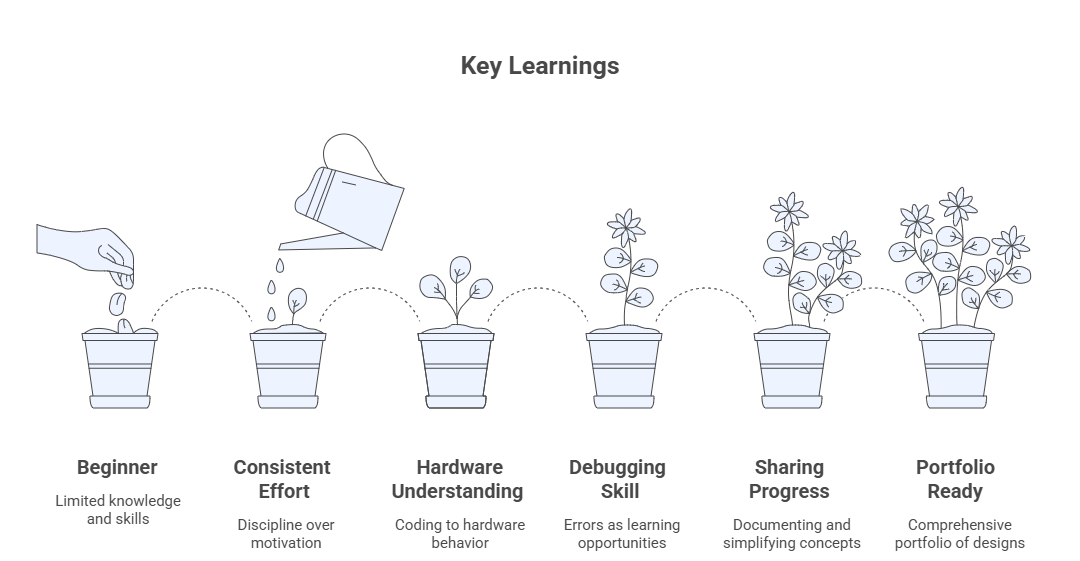
Key Learnings:
Consistency Over Motivation: Discipline was more crucial than motivation. Consistent effort, even for short periods, built momentum.
Thinking in Hardware: My perspective shifted from coding to understanding hardware behavior, which is vital for an RTL engineer.
Debugging as a Skill: I embraced errors as learning opportunities. Debugging became a crucial part of understanding my designs.
Sharing Builds Confidence: Documenting my progress helped simplify concepts, benefiting both myself and others.
Building a Portfolio: I now have a comprehensive portfolio of modules, designs, and verification approaches to showcase.
Why #100DaysOfRTL Matters:
For students and freshers in RTL/VLSI, this challenge offers hands-on practice beyond textbooks, demonstrates commitment to recruiters, helps build a visible portfolio, and shifts learning from passive theory to active design and verification.
Completing #100DaysOfRTL was about more than just writing Verilog or debugging waveforms. It was about developing habits, thinking like an engineer, and pushing myself to grow. If you're considering a similar journey, whether in RTL, coding, or any other skill, I highly recommend it. The transformation is gradual, but after 100 days, you'll see significant growth.
Key Concepts and Components:
Combinational Circuits: Generate outputs based solely on current inputs, performing logical operations with components like adders and multiplexers.
Sequential Circuits: Have memory elements, with outputs depending on current inputs and past states, using components like flip-flops and counters.
Both are essential for designing complex digital systems.
Resources and Tools Used:
ModelSim: For simulating and checking HDL designs.
Quartus Prime: For developing FPGA and CPLD, providing a complete environment for RTL design.
Canva: Used for creating presentations, Posters and documents to showcase projects.
These tools were instrumental in designing, simulating, and presenting my RTL projects effectively.
Today marks the completion of my 100 days of RTL journey a path filled with challenges, learning, and growth.
I’m truly grateful for this experience and for the consistency it helped me build. A special thanks to
Chinna Venkata Narayana Reddy Seelam, who inspired me to start and stay consistent throughout this journey.